
Bookplates, or ex libris, are decorative labels, or stickers, to identify book ownership and for authors to sign.
We now offer this option with letterpress printing and digital/offset printing. If you would like letterpress printing, the artwork needs to be one color and of a resolution of 300 dpi or higher. Crisp, solid lines work best. For either type of printing you may send the artwork to info@bookplateink.com before placing your order if you’d like us to be sure it is suitable. Please read the entire page for more information about ordering custom artwork.
To place an order, click on the appropriate icon and fill out the order form. Pricing information is available in the order form or at https://bookplateink.com/pricing/.

Letterpress

Black Only

Color
Bookplate Ink specializes in printing bookplates using camera-ready artwork provided by our customers. This option is especially popular with authors for book signings or to send signed bookplates to readers. The artwork may include high-resolution photos, scans of artwork on paper, and digitally created work.
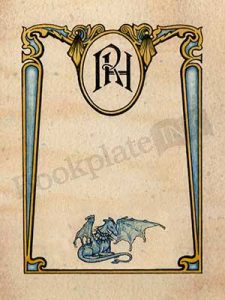
Bookplate for author Robin Hobb (RobinHobb.com)
Artwork by Carol Craig
Universities, religious institutions, museum libraries and non-profit organizations also frequently order bookplates with their own logo or other artwork. Bookplate Ink has also printed designs with custom artwork for baby showers, weddings, corporate events and school birthday clubs.
You can submit camera-ready artwork with all graphics and text included, sized to the fit the bookplate, or you can submit a logo or other artwork and have us set up the text of your choice. If multiple lines of text are added or much design work is needed, there may be an extra charge for design time. We will send a proof by e-mail for your approval before printing. An example of this is shown with Ruth Feldman’s design shown below. She sent the artwork and Bookplate Ink added the text and sizing.

Bookplate for author Ruth Feldman
Design by Bookplate Ink
Files can be submitted in tiff, jpeg, eps, or pdf format. Resolution should be at least 300 dpi for best results. We can print bookplates with black and white or color photographs. If your artwork is to bleed off the edge of the bookplates (this means the artwork or color background goes to the edge of the bookplate), it needs to extend approximately 1/8 inch beyond the perimeter so we can cut the bookplates to the correct size. If your artwork is not available digitally, you can mail it to us at the address below.

Bookplate for comic writer Taneka Stotts (beyond-press.com)
Artwork by Chan Chau (aluhnim.tumblr.com)
Our bookplates are usually 3 inches wide by 4 inches high, but we can print other custom sizes. Please contact us for additional information if you would like a bookplate that is not three inches by four inches. Feel free to send your artwork to check if it is suitable for printing.
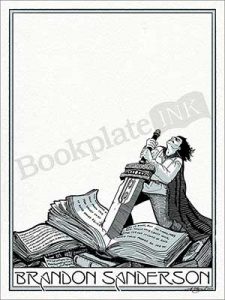
Bookplate for
author Brandon Sanderson (BrandonSanderson.com)
 This past August, my husband and I had the good fortune to travel to Europe. We spent a week in Lucerne, Switzerland, attending spectaular concerts at the renowned Lucerne Music Festival and hiking in the Alps with friends. After traveling by train to Italy, we visited Lucca, Florence and Cinque Terra, walking for miles, and loving the history and beauty of the area.
From there, we took the train to Venice, where we took in many of the wonderful museums and explored the city. One of the museums we visited was the Museo Correr in Venice, Italy. The Correr sits directly across Piazza San Marco from Basilica San Marco, and is steps away from the Grand Canal. There is an awe-inspiring amount of history and culture in just this one small area but I am going to focus on one exhibit in the Correr.
 Within the museum is the Pisani Library, a room filled with beautiful walnut bookcases that came from the Pisani family palace at San Vidal. The Pisanis, an aristocratic family in Venice from the 12th to 18th centuries, were an important influence on the culture and politics of the time. According to the Museo Correr, they were “the first to set up what might be called a library-museum, in an attempt to endow the city’s publishing industry with its own aura of grandeur and munificent service to the State.”
The bookcases today are filled with “rare manuscripts and printed works, dating from the early Sixteenth Century to the end of the  Eighteenth.” Surrounding the shelves are display cases with beautiful books from the 1500-1600s.
The chandelier hanging above was made from Murano glass in the 1700s. Murano is a series of small islands just outside of Venice and has been home to glass-making since 1291, when the glassmakers of Venice were forced to move there due to fear of fire within the city and its wood buildings.
It was fascinating and awe-inspiring to view the intricate artwork in books from hundreds of years ago. I’m grateful that people such as the Pisani family valued their libraries and preserved the world’s heritage through books. During this “digital age,” let’s not forget the importance and endurance of the printed page.
Although bookplates have traditionally been used to identify one’s books in a personal library, many authors order bookplates from Bookplate Ink to use for book signings and as a promotional tool and thank you gift to their readers, so I thought it might be helpful to new authors (and seasoned authors!) to show some possibilities.
One popular option is to have bookplates printed with custom artwork from your book(s). Some authors have bookplates with the artwork from the jacket cover of the book at the top of the bookplate or as the background for the entire bookplate. Sometimes artwork related to one element or character of the book is used, along with the author’s name and/or website.
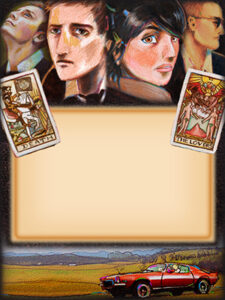 New York Times bestselling author Maggie Stiefvater has used more than one design for her young adult Raven Cycle series. Maggie posts photos and offers signed bookplates through her website, Twitter, Instagram, Facebook, and Fountain Bookstore. We have seen more than one tweet with a photo from an excited reader who just bought one of her books and received a signed bookplate. Shown here is one of the bookplates Stiefvater created for her Raven Cycle series.
Brenna Yovanoff is another young adult fiction writer
who recently ordered bookplates for her new book, Places No One Knows, and posted a photo on Instagram. The book will be released later this month, but those who pre-order through the Tattered Cover Book Store will receive a free signed bookplate. Many authors use a signed bookplate as an incentive for pre-orders.
 Bookplate Ink has also printed bookplates for
New York Times bestseller Garth Stein. His latest bookplate is a good example of a design useful for an author who wants a bookplate that encompasses all of his or her published books. As you can see, the jacket covers of his books are shown at the top along with his photo, while his website address is at the bottom of the bookplate.
If you’re looking for a simpler and more affordable 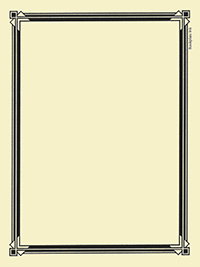 option, another possibility is one of our non-personalized border designs. These bookplates are printed on a non-glossy, cream colored paper and look very classy. At 3×4 inches, they have plenty of room for your signature and a short message. As they’re pre-printed and we keep them in stock, they ship quickly and are less expensive than custom bookplates. Shown here is one of our most popular border designs, N100. It is available as both a non-personalized bookplate or a custom printed bookplate with the text of your choice.
For a more personalized look, many authors order one of our many border designs and have the bookplates custom printed with their name, website address and/or book title. We can also add artwork or a logo to any of our border designs.
There are many possibilities regarding styles and sizes of bookplates. If you have any questions, feel free to call 866-483-3830 or e-mail info@bookplateink.com.
It’s exciting to read a book that really makes history come alive and, as a bonus, makes you feel proud of where you live. That happened for me with David McCullough’s book The Wright Brothers. As Bookplate Ink has deep roots in Yellow Springs, Ohio, which is just outside of Dayton, where the Wright family lived, reading about the lives and work of Wilber and Orville Wright seemed especially relevant to me. If you’re not up on this piece of history, I encourage you to read the book, as it’s interesting and very readable. Bookplate Ink has many customers who are authors, so I don’t usually write about any one book or author, but this book seemed more personal and pertinent after a recent trip into Dayton.
 During this visit, we first went to Woodland Cemetery and Arboretum, where Orville, Wilbur, their parents, and their sister Katherine are all buried. Woodland Cemetery is a beautiful, wooded expanse of rolling hills, and one of the nation’s five oldest rural garden cemeteries, according to their website. In addition to the Wright family, poet (and schoolmate of Orville and Wilber) Paul Laurence Dunbar is buried there. Including Dunbar, the list of grave
  sites contains a “who’s who” list of important people, all from Dayton: inventor Charles Kettering, John Patterson of NCR, George Huffman of Huffy Bicycles, and George Mead of Mead Paper and newspaper columnist Erma Bombeck, among others.
After visiting Woodland, we explored Carillon Historic Park, a 65-acre campus dedicated to preserving the amazing history of Dayton. Just one of the many buildings located there is the John W. Berry Sr. Wright Brothers Aviation Center. The Center includes a model of the Wright Brothers’ bicycle shop, formerly located in Dayton, which housed the workshop where they built their first  gliders and planes. Also in the Center is the original 1905 Wright Flyer III, the world’s first practical airplane. As you can see in the photo, a model of Wilbur Wright is shown flying the plane. One of the things that struck me while reading The Wright Brothers is that Orville Wright died in 1948, which seemed amazingly recent to me. The building where the Flyer is housed was designed by Orville, though he didn’t live to see it built. Our tour guide mentioned that his father-in-law belonged to the Engineer’s Club in Dayton and saw Orville there many times.
I was also amazed that the Wright Brothers were building their first flying machines while the automobile was still very young. McCullough’s book mentions Wilbur and Orville being picked up by carriage, not an automobile, when arriving home by train. In fact, at Carillon Historical Park I learned that the patent for the first electric ignition device for automobiles was granted to Charles Kettering of Dayton in 1915. The early 1900s were a time of great inventiveness and industrialism in Dayton. Imagine living in Dayton in 1905 and being able to visit with Paul Laurence Dunbar, Wilber and Orville Wright, and Charles Kettering, all within walking distance.
 And finally, to tie this all in with bookplates, Bookplate Ink has a beautiful design of an airplane similar to the Wright Brother’s flyer, painted by Dayton native and artist Michael Bonilla. Design C111 is available on white, self-adhesive paper, personalized with your name or the text of your choice.
My husband and I recently spent a few days in New York City, visiting our son. In addition to visiting the Metropolitan Museum of Art and the Whitney Museum of American Art (both of which I heartily recommend), we took a tour of the Stephen A. Schwarzman Building of the New York Public Library. What a wonderful experience! And free!
The tour was given by a vivacious, enthusiastic and knowledgeable  volunteer, who brought amazing history to life throughout the library. The building was constructed on the foundation of a reservoir, with the cornerstone laid in 1902.
 Before you even enter the building, you are greeted by two iconic statues. The majestic lions, nicknamed Patience and Virtue, are made of a rose-colored marble. Once inside the front lobby, the gorgeous huge front windows are worth turning around to view.
The first room we visited was the Dewitt Wallace Periodical Room. According to the tour guide, DeWitt and Lila Bell Wallace spent many hours reading and cultivating articles from the Library’s collection before founding the Reader’s Digest Magazine in 1922. The Wallaces  gave generously after becoming wealthy and The Wallace Foundation funded the restoration in 1983 of The Periodical Room that served as their informal editorial office. The ornate ceiling looks like wood but is actually plaster. The beautiful murals are described in detail on the library website.
Another highlight of the tour was the Gutenberg Bible on display upstairs. Johannes Gutenberg was the first European to us e movable metal type in the production of books, a much faster system than handwriting or woodblock print. The New York Public Library’s copy of the Gutenberg Bible, one of only about 180 produced, was donated by James Lenox, who was one of the co-founders of the library.
Surrounding the Gutenberg Bible is a set of four arched murals called The Story of the Recorded Word. These murals, created between 1938 to 1942, were part of a Works Progress Administration (WPA) project. The first mural shows Moses with the Ten Commandments, as depicted in Exodus of the Old Testament; in the second a monk from the Middle Ages copies a manuscript; the third mural shows Gutenberg with a proof of his Bible; and the fourth depicts Ottmar Mergenthaler at a linotype machine.
This is only a small portion of the artwork and information shown us during the tour. I would encourage you to visit yourself if you are able. For more information about the New York Public Library, visit their website at https://nyclib.com/.